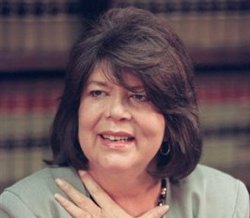
Wilma Pearl Mankiller
Wilma Pearl Mankiller was born in 1945 in Tahlequah, Cherokee County, Oklahoma, to Charley Mankiller and Clara Irene (Sitton) Mankiller. In 1950, Wilma was living with her parents and six siblings in Wauhillau, Adair County, Oklahoma. Her father was working as a farm laborer; all members of her family identified as native American.
Arizona Republic, 8 April 2010: “Wilma Mankiller, 64, the first female chief of the Cherokee Nation in modern times, whose leadership on social and financial issues made her tribe a national role model, has died at her home in Adair County, Okla. She had metastatic pancreatic cancer. Mankiller, principal chief of the Cherokee from 1985 to 1995, tripled her tribe’s enrollment, doubled employment, and built new housing, health centers and children’s programs in northeastern Oklahoma, where most of the 200,000 or so tribal members live. In 1990, she signed an unprecedented agreement in which the Bureau of Indian Affairs surrendered direct control over millions of dollars in federal funding to the tribe. She died Tuesday. Although women have long played leadership roles in Native American communities, few before Mankiller were elected to the top position of one of the country’s largest tribes. “She was the first to step forward, although that’s vastly changed in the last 20 years. Many [women] are now heads of their tribes because of her,” said Susan Masten, past chairman of the Yurok Tribe, who also founded Women Empowering Women for Indian Nationals. Under Mankiller’s leadership, infant mortality declined and educational achievement rose, although she was quick to say much more needed to be accomplished. Then-President Bill Clinton awarded her the Presidential Medal of Freedom in 1998, and she was inducted into the National Women’s Hall of Fame in 1993. She was born Nov. 18, 1945, in Tahlequah, Okla., one of 11 children and a fifth-generation Mankiller. Her surname was an old term of respect for Indian warriors who guarded tribal villages. “It’s a nickname, and I earned it,” she would sometimes tease inquirers. After drought devastated her family’s land in the 1950s, the U. S. government moved them to a housing project in California where the adolescent Mankiller experienced culture shock, exacerbated by poverty and racism. She married an Ecuadoran accountant, Hector Olaya, in 1963, and they had two daughters, Felicia Olaya and Gina Olaya, both of whom survive her, as well as four grandchildren and several great-grandchildren. After divorcing Olaya, she moved back to her family’s Oklahoma land in 1977 and became the tribe’s community-development director. Mankiller was elected deputy chief of the tribe in 1983 and in 1985, when principal Chief Ross Swimmer left to become director of the U. S. Bureau of Indian Affairs, Mankiller filled the vacancy. She remarried in 1986 to Charlie Soap, a Cherokee community developer and organizer, who encouraged her to run for the principal chief’s job in 1987, and who also survives her.”
St. Louis Post-Dispatch, 8 April 2010: “Wilma Mankiller, who as the first woman to be elected chief of a major American Indian tribe, revitalized the Cherokee National’s tribal government and improved its education, health and housing, died on Tuesday (April 6, 2010) at her home near Tahlequah, Okla. She was 64. The cause was pancreatic cancer, said Mike Miller, a tribal spokesman. Ms. Mankiller was the Cherokee chief from 1985 to 1995, and during her tenure the nation’s membership more than doubled, to 170,000 from about 68,000. While many Cherokees live in a 14-county area around the tribal capital of Tahlequah, in eastern Oklahoma, the tribe’s members are spread throughout the 50 states. The current tribal membership is 290,000, making it the second-largest tribe in the country after the Navajo. Ms. Mankiller was admired for her tenacity, having fought off two serious diseases, lymphoma and a neuromuscular disorder called myasthenia gravis; recovered from kidney failure that would have killed her had not an older brother given her one of his kidneys; and survived a head-on automobile collision in 1979 that forced her to endure 17 operations and years of physical therapy. “We are better people and a stronger tribal nation because of her example of Cherokee leadership, statesmanship, humility, grace, determination and decisiveness,” Chad Smith, the Cherokees’ principal chief, said in a statement on the tribe’s website. “When we become disheartened, we will be inspired by remembering how Wilma proceeded undaunted through so many trials and tribulations.” Wilma Pearl Mankiller was born on Nov. 18, 1945, in Tahlequah. She was the sixth of 11 children reared by Charley Mankiller, a full-blooded Cherokee, and the former Clara Irene Sitton, who is of Dutch-Irish descent. (The Cherokees accept anyone as a member who can link any part of his or her ancestry to a member of the original tribe.) Ms. Mankiller spent her early childhood on a 160-acre tract known as Mankiller Flats, given to her grandfather as part of a settlement the federal government made for forcing the Cherokee to move to Oklahoma from their tribal lands in the Carolinas and Georgia in the 1830s. The name Mankiller comes from a tribal military rank. Though Ms. Mankiller later recalled that she had never really felt poor growing up, the family’s home had no electricity, indoor plumbing or telephones. In addition to her mother, among the survivors are her husband, Charlie Soap; two daughters, Gina Olaya and Felicia Olaya, both of Tahlequah; several brothers and sisters; and four grandchildren. In 1998, President Bill Clinton awarded Ms. Mankiller the Medal of Freedom, the nation’s highest civilian honor.”


Comments
Post a Comment